Surveying the Construction of Global Knowledge/Spaces for the ‘Knowledge Economy’

Search Blogs

  • Keyword Search

  • Filter by:

  • Filter by:

GlobalHigherEd

Surveying the Construction of Global Knowledge/Spaces for the ‘Knowledge Economy’

By Kris Olds July 23, 2011 8:15 am EDT

Editors' note: the statement below was issued by participants at the end of the International Conference on Decolonising Our Universities conference at Universiti Sains Malaysia (June 27-29, 2011, Penang, Malaysia). We've posted it here as it facilitates consideration of some of the taken-for-granted assumptions at play in most debates about the future of higher education right now. This statement, most of the talks presented at it, and this memorandum to UNESCO, reflect an unease with the subtle tendencies of exclusion (of ideas, paradigms, models, options, missions) evident in the broad transformations and debates underway in most higher education circles, including in rapidly changing South and Southeast Asia. Our thanks to the organizers, especially Vice-Chancellor Professor Tan Sri Dato’ Dzulkifli Abdul Razak, and Emeritus Professor Datuk Dr. Shad Saleem Faruqi, for information about the event. Kris Olds & Susan Robertson

~~~~~~~~~~~~~~~~~~~

Another World is Desirable

We – people from diverse countries* in four continents – met in your lovely city of Penang for three days from June 27-29, 2011. We were invited by Universiti Sains Malaysia and Citizens International to discuss the future of our universities and how we could decolonise them. Too many of them have become pale imitations of Western universities, with marginal creative contributions of their own and with little or no organic relation with their local communities and environments. The learning environments have become hostile, meaningless and irrelevant to our lives and concerns.

In all humility, we wish to convey to you the gist of our discussions.

We agreed that for far too long have we lived under the Eurocentric assumption – drilled into our heads by educational systems inherited from colonial regimes – that our local knowledges, our ancient and contemporary scholars, our cultural practices, our indigenous intellectual traditions, our stories, our histories and our languages portray hopeless, defeated visions no longer fit to guide our universities – therefore, better given up entirely.

We are firmly convinced that every trace of Eurocentrism in our universities – reflected in various insidious forms of western controls over publications, theories and models of research must be subordinated to our own scintillating cultural and intellectual traditions. We express our disdain at the way ‘university ranking exercises’ evaluate our citadels of learning on the framework assumptions of western societies. The Penang conference articulated different versions of intellectual and emotional resistance to the idea of continuing to submit our institutions of the mind and our learning to the tutelage and tyranny of western institutions.

We leave Penang with a firm resolve to work hard to restore the organic connection between our universities, our communities and our cultures. Service to the community and not just to the professions must be our primary concern. The recovery of indigenous intellectual traditions and resources is a priority task. Course structures, syllabi, books, reading materials, research models and research areas must reflect the treasury of our thoughts, the riches of our indigenous traditions and the felt necessities of our societies. This must be matched with learning environments in which students do not experience learning as a burden, but as a force that liberates the soul and leads to the upliftment of society. Above all, universities must retrieve their original task of creating good citizens instead of only good workers.

For this, we seek the support of all intellectuals and other like-minded individuals and organisations that are willing to assist us in taking this initiative further.

Thank you for hosting us, the Delegates of the International Conference on Decolonising Our Universities, June 27-29. 2011, Penang, Malaysia

For more information please access www.multiworldindia.org

*Australia, China, India, Indonesia, Iran, Japan, Malaysia, Nigeria, Philippines, Singapore, South Korea, Taiwan, Tanzania, Thailand, Turkey, Uganda

By Kris Olds July 19, 2011 12:30 pm EDT

One notable challenge for many universities is moving beyond the superficial rhetoric of internationalization. Of course every university, and its leaders, are in favor of internationalizing: the signs are everywhere, from refashioned mission statements, to the building of some institutional capacity to understand and support internationalization, to the inclusion of the rhetoric of internationalization in speech after speech by university leaders.

Yet, in the end, the process of enhancing the territorial spread of institutional networks, and sometimes architectures, is not so simple: it requires the initiation and implementation of a strategic planning process, and the subsequent bringing to life of new linkages, partnerships, programs, and projects. For some this involves a top-down led process of almost turning the university inside out (e.g., NYU), while for others it involves the slow and steady development of an infrastructure of support to enable units within a university to go at their own speed, in their own ways, free of formal managerialism where one unit (and often person) is deemed the defacto czar of internationalization.

Regardless of approach, one of the noteworthy aspects of this phenomenon is its formalization. What I mean by this is institutions of higher education are increasingly attempting to become more strategic in a comprehensive and legible way. Audits of international teaching and research activities are being conducted, and universities are ramping up their coordination capabilities via advisory councils, task forces, and ad-hoc working groups. The best universities build in accountability and outcome measures to see what is really happening over time. This sometimes involves more staff versus additional resources for faculty and students, for good and for bad (see, for example, the vigorous debate about the rise of ‘deanlets’ and ‘deanlings’ in 'The Fall of the Faculty', Inside Higher Ed, 14 July 2011).

In any case, the effort to become more strategic, and formal, about internationalization is abundantly evident in a new report released yesterday by the UK Higher Education International and Europe Unit. This report -- A Guide to UK Higher Education and Partnerships for Overseas Universities -- is designed to serve as a “starting point for overseas institutions interested in establishing collaborations with UK higher education institutions." As noted in the report’s executive summary:

Partnerships between academic institutions have tended to be the product of working relationships between individual academics; but more recently, as the potential benefits and risks from overseas collaborations have increased, universities and colleges have begun to manage their international partnerships portfolio more effectively.

Increasing competition is affecting the way UK universities think about their aspirations and how to maintain their international competitiveness. A strategic shift is underway – away from a focus on international student recruitment (at which the UK sector has been successful) and toward a longer-term and more partnership based conceptualisation of internationalisation.

Governments around the world are increasingly encouraging their universities to embrace the international agenda and to internationalise their institution. They are doing this by supporting and facilitating their higher education sectors to engage at an institutional level with global partners through teaching and research collaboration.

The free 52 page report, which is available in PDF format in English, Arabic and Chinese, is worth reading for even if you are not interested in partnering with UK universities the report helpfully sets out a series of issues worth thinking about in general at both the university level (i.e. how to frame and implement partnerships) as well as the larger system-wide scale.

For example, the report prompted me to reflect on the issue of what associations of universities could do to better communicate about, in summary form, the taken-for-granted factors shaping the national systems of higher education and research their own universities are embedded in. And if this were to happen, what language(s) should this form of communications occur in? What format should these types of ‘primers’ be available in, and at what cost (if any)? And whom should we be communicating with as we lay out some of the groundwork for the hoped for formation of partnerships? Similarly, do we, at the university scale, provide sufficient analytically oriented information, in one place on our websites, about the history, nature of, and entry points (with respect to governance), regarding our universities that prospective overseas partners would find beneficial to read prior to visits and negotiations?

Of course partnerships, in the end, need to be brought to life at the university to university level, but keep it in mind that the diversity of systems out there mean that many universities need approval from ministries or government departments before they can engage in partnerships, especially if year-on-year resource expenditures are to be factored in. Given this many government officials, ministers (or equivalents), and some unexpected others, have power to shape relationship building outcomes even though they frequently do not have an understanding of issues like academic freedom, quality assurance, institutional governance, research and teaching outcome expectations, etc. All the more reason for communicating about who we are, and are not.

While hardly perfect, my read of A Guide to UK Higher Education and Partnerships for Overseas Universities leads me to believe that its authors and sponsors are attempting to provide a primer of this type; one for ‘overseas universities’ as well as the other actors who will have an impact on the partnership relationship building process. It is also a reflexive piece; one reminding those guiding UK universities to think about the taken-for granted factors that shape their practices and expectations. In the end these kinds of communications objectives cannot but be positive for failed or unrealized partnerships (and there are many the higher education sector) generate ample opportunity costs that we can scarcely afford.

By Kris Olds July 13, 2011 11:28 am EDT

The development of linkages between higher education systems in a variety of ‘world regions’ continues apace. Developments in Europe, Asia, Africa, the Gulf, and Latin America, albeit uneven in nature, point to the desire to frame and construct regional agendas and architectures. Regionalism -– a state-led initiative to enhance integration to boost trade and security -- is now being broadened out such that higher education, and research in some cases, is being uplifted into the regionalism impulse/dynamic.

The incorporation of higher education and research into the regionalism agenda is starting to generate various forms of interregionalisms as well. What I mean by this is that once a regional higher education area or research area has been established, at least partially, relations between that region, and other regions (i.e. partners), then come to be sought after. These may take the form of relations between (a) regions (e.g., Europe and Asia), (b) a region and components of another region (e.g., Europe and Brazil; Latin America and the United States; Southeast Asia and Australia). The dynamics of how interregional relations are formed are best examined via case studies for, suffice it to say, not all regions are equals, and nor do regions (or indeed countries) speak with singular and stable voices. Moreover some interregional relations can be practice-oriented, and involve informal sharing of best practices that might not formally be ‘on the books.’

Let me outline two examples of the regionalism/interregionalism dynamic below.

ALFA PUENTES

The first example comes straight from an 8 July 2011 newsletter from the European University Association (EUA), one of the most active and effective higher education institutions forging interregional relations of various sorts.

In their newsletter article, the EUA states (and I quote at length):

The harmonisation agenda in Central America: ALFA PUENTES sub-regional project launch (July 07, 2011)

EUA, OBREAL, HRK and university association partners from Costa Rica, Guatemala, Honduras, Panama, and Mexico gathered in Guatemala City on 27-28 June both to discuss and formally launch the sub-regional project ‘Towards a qualifications framework for MesoAmerica’, one of the three pillars of the European Commission supported structural project ‘ALFA PUENTES’ which EUA is coordinating.

Hosted by sub-regional project coordinator CSUCA (Consejo Universitario CentroAmericana), and further attended by the sub-regional coordinators of the Andean Community (ASCUN), Mercosur (Grupo Montevideo), partners discussed current higher education initiatives in Central America and how the ALFA PUENTES project can both support and build upon them.

CSUCA, created in 1948 with a mission to further integration in Central America and improve the quality of higher education in the region, has accelerated its agenda over the past 10 years and recently established a regional accreditation body. This endeavour has been facilitated by project partner and EUA member HRK (in conjunction with DAAD) as well as several other donors. The association, which represents around 20 public universities in Central America, has an ambitious agenda to create better transparency and harmonisation of degrees, and has already agreed to a common definition of credit points and a template for a diploma supplement.

Secretary General Dr Juan Alfonso Fuentes Soria stated in a public presentation of the project that ALFA PUENTES will be utilised to generate a discussion on qualifications frameworks and how this may accelerate the Central America objectives of degree convergence. European experience via the Bologna Process will be shared and European project partners as well as Latin American (LA) partners from other regions will contribute expertise and good practice.

ALFA PUENTES is a three-year project aimed at both supporting Latin American higher education convergence processes and creating deeper working relationships between European and Latin American university associations. Thematic sub-regional projects (MesoAmerica, Andean Community and Mercosur) will be connected with a series of transversal activities including a pan-Latin American survey on change forces in higher education, as well as two large Europe-LA University Association Conferences (2012 and 2014).

This lengthy quote captures a fascinating array of patterns and processes that are unfolding right now; some unique to Europe, some unique to Latin America, and some reflective of synergy and complementarities between these two world regions.

TUNING the Americas

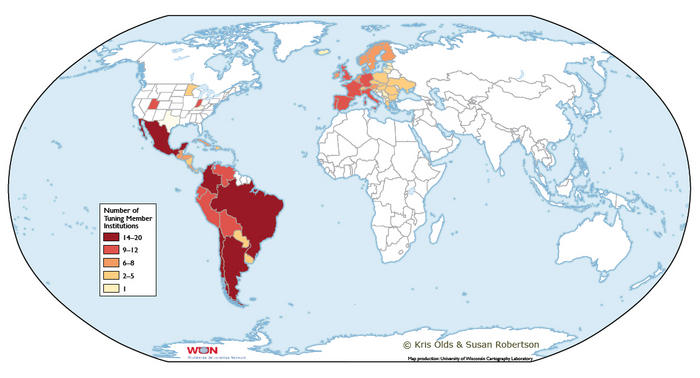
The second example, one more visual in nature, consists of a recent map we created about the export of the TUNING phenomenon. As we have noted in two previous GlobalHigherEd entries:

  • TUNING USA: Echoes and translations of the Bologna Process in the US higher education landscape (26 January 2010)
  • ‘Tuning USA’: reforming higher education in the US, Europe style(28 April 2009)

TUNING is a process launched in Europe to help build the European Higher Education Area (EHEA). As noted on the key TUNING website, TUNING is designed to:

Contribute significantly to the elaboration of a framework of comparable and compatible qualifications in each of the (potential) signatory countries of the Bologna process, which should be described in terms of workload, level, learning outcomes, competences and profile.

The TUNING logic is captured nicely by this graphic from page 15 of the TUNING General Brochure.

Over time, lessons learned about integration and educational reform via these types of mechanisms/technologies of governance have come to be viewed with considerable interest in other parts of the world, including Africa, North America, and Latin America. In short, the TUNING approach, an element of the building of the EHEA, has come to receive considerable attention in non-European regions that are also seeking to guide their higher educational reform processes, and as well as (in many cases) region-building processes.

As is evident in one of several ‘TUNING Americas’ maps we (Susan Robertson, Thomas Muhr, and myself) are working on with the support of the UW-Madison Cartography Lab and the WUN, the TUNING approach is being taken up in other world regions, sometimes with the direct support of the European Commission (e.g., in Latin America or Africa). The map below is based on data regarding the institutional take-up of TUNING as of late 2010.

Please note that this particular map only focuses on Europe and the Americas, and it leaves out other countries and world regions. However, the image pasted in below, which was extracted from a publicly available presentation by Robert Wagenaar of the University of Groningen, captures aspects of TUNING’s evolving global geography.

Despite the importance of EU largesse and support, it would be inaccurate to suggest that the EU is foisting TUNING on world regions; this is the post-colonial era, after all, and regions are voluntarily working with this European-originated reform mechanism and Europe-based actors. TUNING also only works when faculty/staff members in higher education institutions outside of Europe drive and then implement the process (a point Robert Wagenaar emphasizes). Or look, for example, at the role of the US-based Lumina Foundation in its TUNING USA initiative. Instead, what we seem to have is capacity building, mutual interests in the ‘competencies’ and ‘learning outcomes’ agenda, and aspects of the best practices phenomenon (all of which help explain the ongoing building of synergy between the OECD’s AHELO initiative with the European/EU-enabled TUNING initiative). This said, there are some ongoing debates about the possible alignment implications associated with the TUNING initiative.

These are but two examples of many emerging regionalisms/interregionalisms in the global higher education landscape; a complicated multiscalar phenomenon of educational reform and ‘modernization,’ and region building, mixed in with some fascinating cases of relational identity formation at the regional scale.

Kris Olds (with thanks to Susan Robertson & Thomas Muhr)

By Kris Olds July 1, 2011 1:45 pm EDT

A cold summer ale on the Memorial Union Terrace (or 'the Terrace' as it is known) at UW-Madison is a genuinely glorious experience. I was down there the other evening with my family, observing students, faculty, visiting conference types, as well alumni and members of the public. The Terrace functions like a defacto community center, alongside all of the functions typically associated with student unions (including food services, the weak link in an otherwise splendid set-up). UW-Madison is facing some serious challenges right now, but it has basically nailed the student union experience like few other universities have.

The wonders of the Terrace became clearer a few weeks ago when I drove up to Ottawa to give a talk at an Association of Universities and Colleges of Canada (AUCC) workshop on Canada-Brazil higher education relations. I brought my two sons with me, and we stopped at a number of universities in Ontario and Quebec. And while I know of Canadian universities first-hand as a University of British Columbia (UBC) alum (BA & MA), this was the first time I wore the parental hat given that my eldest son is now thinking of which universities to apply to.

Canadian university campuses are generally well-planned contexts for a high quality education. Yet many (not all!) of them continue to segregate social spaces on the basis of identity/status (undergraduates, graduate, faculty, staff), with a curious concrete bunker-like ambiance provided for undergraduates when they become old enough to have that cold summer ale. This is a pattern I’ve also seen in a variety of other countries with respect to their on-campus or university-affiliated establishments.

Of course I recognize that over-drinking is a serious problem on university campuses, and that there are significant cultural-regulatory matters to factor in, but does segregating the university community into broad bands of social drinkers help, or hurt? I’d argue that creating more socially mixed settings, complete with alumni and members of the host city/town, engenders more mature behavior, and creates the kind of ambiance that makes a campus an even more valuable contributor to social life in the place it is situated in.

For example, I loved my UBC experiences as an undergraduate, but did they really have to relegate us to ‘The Pit’, a windowless basement bunker, when we wanted to have an on-campus social gathering with a few beer. That kind of experience, fun as it was (and it was fun!), cannot match the wonders of the Terrace, or the beer gardens associated with the University of Vienna, for example.

Despite what I've said, attention to the undergraduate experience is significantly changing on campuses in Canada, and elsewhere. And these experiences are being improved, not worsened. Undergraduates become, after all, alumni and universities everywhere will be depending upon alumni for streams of revenue like never before. And judging from what I detect here in Madison, the intangibles of warm summer breezes, joyous conversations, tasty summer ales, and being treated with respect, cannot but help deepen the positive memories and social ties that engender support for a university down the line.

Happy Canada Day & Happy Independence Day!

By Kris Olds & Susan Robertson June 28, 2011 9:30 am EDT

Dear colleagues,

After experiencing the busiest academic years of our respective lives, we’ve decided to adjust the pitch of GlobalHigherEd, somewhat, and include a broader mix of long (for a weblog) analytical entries with shorter updates regarding important new reports, interesting visualizations, video clips, links to key stories or event-related websites, and so on. This should enable us to keep the weblog moving on a more measured pace, and also complement our active Twitter feed (which now has 2,700+ followers).

Alas, the pace of life when GlobalHigherEd was launched -- during sabbaticals in Paris (Kris) and Amsterdam (Susan) -- won’t be returning soon so our aspirations to only post longer (1,200-2,000 word) analytical entries has now become unrealistic. We’ll be sure, though, to keep the tone and focus of GlobalHigherEd the same as we continue to map out what is a fascinating, complicated, and ever-evolving global higher education and research landscape.

By Kris Olds April 21, 2011 7:36 am EDT

Note: our thanks to the Worldwide Universities Network (WUN) for the funds to create this map, and to the University of Wisconsin-Madison Cartography Lab for creating it. Further details on the Bologna Process and the European Higher Education Area are available here and here.

By Kris Olds April 10, 2011 5:00 pm EDT

GlobalHigherEd is still alive, I assure you! Unfortunately, our respective responsibilities, and some surprises, have been all consuming of late.

Over in Bristol, Susan has been busy with a recent keynote in the Gulf region on the intersections of the public and private; a talk that drew material from her contribution to a fascinating project on the conceptualization of public-private partnerships, including in higher education. This project, which will be published in book form, ties into our broader interests in the desectorialization and denationalization of higher education.

Across the Atlantic, in Madison WI, the last 1.5-2 months have been rather unique, to say the least! Apart from the ‘usuals’, I’ve had my head down creating a new on-line (virtual) course titled World Regions: Problems and Concepts, while also being engaged in debates about the proposed New Badger Partnership (NBP); an initiative which organizationally and symbolically pulls UW-Madison out of the UW System, providing it with greater autonomy over governance matters, albeit with uncertainty (to date) about process, structure, and outcomes. My colleague, William Cronon, was also hit with an open records claim by the Republican Party of Wisconsin; a development that spiraled into a national media issue. Who said life in the ‘flyover zone’ (as the US Midwest is sometimes deemed) is boring! All of these topics will serve as rich empirical cases for entries over the next several months as we try to come up for air, and shed light on some of the more 'global' dimensions of these issues in GlobalHigherEd.

Apart from the above, we’ve also been working to launch a GlobalHigherEd visualization initiative. This initiative, backed by some valuable seed funding via the Worldwide Universities Network (WUN), is fueling the development of a series of visualizations about phenomena associated with the globalization of higher education and research. Curiously, these phenomena are remarkably under-visualized. To be sure there are some excellent graphics in reports like the OECD’s annual Education at a Glance series, or Olivier H. Beauchesne’s fantastic Map of Scientific Collaboration Between Researchers, but really, when you think about it, there are remarkably few informative visualizations (both static and dynamic) about phenomena like student mobility, regionalism and interregionalism, international collaboration, evolving modes of knowledge production, branch campuses, emerging forms of global governance, the uneven spread of private higher education, and so on.

The map below – a static (circa 2009) visualization of the branch campus phenomenon, is based upon the OBHE's 2009 report International Branch Campuses: Markets and Strategies.

To be sure we all know that the branch campus phenomena is associated with a very uneven development pattern, but it is only via graphics like these that the uneven global geography is discernable. And as visualizers know, images like these do work and travel easily, including to contexts where language barriers to the consumption of text (typically in English) are high.

Over time we expect to develop many more visualizations. Future visualizations will be both static and dynamic, and include those that attend to change over time.

If you have any suggestions for topics or themes that lend themselves to being visualized, please email Kris <olds@geography.wisc.edu>, Susan <S.L.Robertson@bristol.ac.uk>, and cc our wonderful cartographer Tanya Buckingham <tbuckingham@wisc.edu>, assistant director of UW-Madison’s Cartography Laboratory.

By Kris Olds February 24, 2011 10:15 am EST

It is not very common to see marches of tens of thousands of people in small cities like my hometown of Madison, Wisconsin (with a population of approximately 235,000 people). The issue that drew about 13,000 into the State Capital area on 15 February, 10-20,000 people on 16 February, 25,000 people on 17 February, 35-40,000 people on 18 February, 60-100,000 people on 19 February, and tens of thousands every subsequent day to the present moment, relates to the decision of the recently elected Republican Governor of Wisconsin (Scott Walker) to unilaterally remove the right of public sector unions to collectively bargain about employment-related benefits. The proposal also repeals, in perpetuity, the rights of some segments of society (including day care workers, faculty and academic staff) to collectively bargain at all, and will generate a defacto pay cut for all people associated with universities of 8+% if it proceeds.

As a Canadian who has lived in several countries generating regular surpluses, but WI resident and taxpayer since 2001, the State's fiscal challenges are evident to me. However this 'budget repair' bill proposal is clearly underpinned not by a logical 'share the pain' approach, but by an ideologically-derived agenda regarding the posited rights (or not, in this case) of certain types of American citizens to engage in deliberations about their working arrangements and conditions. I can't help but wonder how politicians who preach about democracy, human rights, and the value of a 'small government' approach, can rationalize an abrupt rebalancing agenda driven by defacto 'big government' approach that exudes surprising elements of authoritarianism and anti-democratic impulses. Isn't this a deliberative democracy? Why no negotiations and civil dialogue via organized fora, speaking tours throughout the state with budgetary Q&A sessions, etc.? But, as E.J. Dionne of the Washington Post put it:

If this were just about normal budget cutbacks, the political earthquake we're seeing in Wisconsin would not have happened. This is an effort by a temporary majority -- I use the term because in a democracy, all majorities are, in principle, temporary -- to rush a bill through the legislature designed to alter the balance of political power in the state.

Amazing, and a sign of the intersection of developmental debates at the state level with US-scale political currents regarding class politics, aspirational leadership positioning, and socio-economic networks (including the über rich/conservative Koch Brothers, and their organization Americans for Prosperity, as pointed out by the New York Times, Washington Post, and Mother Jones). Indeed the Koch Brothers have just opened up a lobbying office in Madison, and are launching, today, a $342,200 TV ad in support of Walker according to the Capital Times.

If these proposed changes proceed, the implications are profound and on a number of levels and scales, a point made by Governor Walker himself in the New York Times:

The images from Wisconsin — with its protests, shutdown of some public services and missing Democratic senators, who fled the state to block a vote — evoked the Middle East more than the Midwest.

The parallels raise the inevitable question: Is Wisconsin the Tunisia of collective bargaining rights?

Governor Walker, in an interview, said he hoped that by “pushing the envelope” and setting an aggressive example, Wisconsin might inspire more states to curb the power of unions. “In that regard, I hope I’m inspiration just as much as others are an inspiration to me,” he said.

This strategy is fundamentally dependent upon sowing the seeds of discontent between workers; something more easily done in a context of economic crisis and recession. This was certainly evident around the State Capital building on Saturday 19 February when I spent time listening to supporters of Walker lambasting other workers (for many of Walkers supporters were employees too, not employers) about the nature of their health care and pension benefit packages, and their ability to collectively bargain. The sad thing is this hoped-for inter-worker conflict, and defacto race downwards (in pay, benefits, and working conditions), is being encouraged by ostensible 'leaders' like Governor Walker. This is a cynical and short-sighted type of politics if there ever was one. But as Jeffrey Sommers rightfully points out in The Guardian on 22 February:

In short, it has been a return of the mean season. Briefly, in 2008, this frustration was directed against the Republicans. Yet, the Democrats delivered no tangible gains for labour since taking power then, and now, the right has helped steer working-class anger away from Wall Street and back to Main Street's teachers and public employees. Deftly executed, private sector workers without benefits now blame workers who do have them as the cause of their deprivation. Instead of seeing the gains unions can deliver, private sector workers now take the lesson that these gains have somehow been taken at their expense – all the while ignoring the trough-feeding that continues unabated on Wall Street.

The new class war, as it is actually perceived, is not between workers and capital, but between private and public sector workers, with the fires generously stoked by the billionaire Koch brothers and rightwing money generally. One can only imagine Mr Burns of the Simpsons hatching such a scheme in caricature of capital; but this is real, and few seem to recognise the irony as they play out their scripted parts.

As noted above, the politics and political effects associated with the protests are growing, and getting connected to some stronger national and now international currents, not all of which are based upon a recognition of what is going on on the ground right now, with caricatures of all sorts being inaccurately drawn.

In the end, however it turns out, and regardless of political standpoint, it is important for all people to realize the important role, and strongly felt views, and breathtaking energy, of Madison's university students, and their organizations (e.g., the ASM, Badger Herald, Daily Cardinal, TAA) in engendering critically important discussion and debate here. I really can't say enough about their commitment, professionalism, good humor, empathy for older and very different types of people (e.g., union members from northern WI), and absolute grace under pressure. And while 'off-the deep end' ideologues like Indiana's deputy attorney general urged police to use live ammunition against Wisconsin protesters (I'm sadly not joking), what will leave a lasting legacy, in ever so many minds, is the critically important role of students (both university and high schoolers) in shaping a window of February 2011 that is of genuine historic import.

In closing, here are three short videos that capture aspects of the university (and high school) student presence I noted above. The first two were produced by 22 year old Matt Wisniewski, and the third by PhD student Shahin Izadi. A fourth, by Madisonian Finn Ryan, focuses on the broader segments of society who have also been active, in an equally positive and constructive way, in conveying their dissatisfaction with the Walker agenda.

By Kris Olds February 10, 2011 4:00 pm EST

Higher education institutions around the world are feeling increased pressure to deepen inter-institutional connections and accelerate human mobility. For example, the emergence of ‘global challenges’ such as climate change, disease pandemics, and immigration are leading to mission and organizational repositioning; a dynamic explored in our nine-part (to date) ‘Question’ series.

It is in this context that we need to situate the development and governance of international dual and joint degrees. The opportunities and constraints, as well as risks and rewards, of establishing such collaborative degrees are significant: they have the capacity to alter the educational mission of universities, recast the educational experiences of students, transform the learning outcomes of courses and programs, deepen network relations between universities, and provide a tool for differentiating programs and institutions.

These impacts aside, international collaborative degrees are very resource consuming to establish and sustain, complicated to govern, and difficult to assess regarding impact over time. This partly explains the ongoing efforts of the Freie Universität Berlin and the IIE to conduct the second in a series of important survey about such degrees (further information about the Survey on International Joint and Dual/Double Degree Programs is pasted in at the bottom of this entry). It also explains why the US Council of Graduate Schools (CGS) facilitated some substantial discussion and debate that led to the release of a 2010 report Joint Degrees, Dual Degrees, and International Research Collaborations: A Report on the CGS Graduate International Collaborations Project, and why the European Commission helped fund the informative JOIMAN initiative.

Remarkably, one of the major challenges faced by universities seeking to establish international collaborative degrees is to simply define what they are. And trust me – there are dozens of definitions out there, many of which are vague and indeed contradictory.

What follows are some definitions that were developed in the context of a University of Wisconsin-Madison Dual/Joint Degree Working Group that I participated on in 2010, and which was convened by the dean (Gilles Bousquet) of our Division of International Studies.

Over the course of conducting research on international collaborative degrees to devise our own definitions, and some ‘governance pathways’ for such degrees, it became apparent that there was value in situating dual and joint degrees in a broader internationalization/inter-institutional context. In the end, we developed the following typology which outlines modes of international collaboration that include international dual and joint degrees:

  • Study abroad
  • UW‐Madison as a study abroad site for other universities
  • Student exchange agreements
  • Course‐to‐course transfer of credit, Transfer agreements
  • Articulation agreements
  • Third party contracts for educational delivery
  • Off‐campus program or course location
  • Distance education, distance delivery of educational programs
  • Collaborative course or program sharing
  • Sequential degrees
  • Dual degrees
  • Joint degrees

Not all of these modes of international collaboration, as we deem them, are practiced at UW-Madison.

The DRAFT Working Group reports that were written in 2010 are currently being reviewed within our administrative machinery, but are publicly accessible via the University Academic Planning Council website should you be interested in them. Jocelyn Milner, Associate Vice Provost and Director, Academic Planning and Analysis, was the lead author of the two reports that we all provided input on.

Given that many other institutions are also struggling with the issue of how to handle international dual/joint degrees, I’ll take the above typology, and edit out the Madisonian elements of the definitions, thereby providing you (from University X) with some definitions worth reflecting on and debating.

Needless to say, I would appreciate being sent your university’s reports about international collaborative degrees, assuming some exist and can be made public. You can email them to me at <kolds@wisc.edu> or list them in the comments section to this entry. I’ll compile the responses, knit them in with the resources we’ve collected over the last year (some of which are available here), and create a subsequent entry in GlobalHigherEd that outlines all available resources (books, reports, websites) for universities considering the establishment of international collaborative degrees. In short, today’s entry is a defacto call for more collaboration and information sharing about an emerging global higher ed phenomenon; one that is being driven forward for a range of reasons, yet is not so simple to bring to life and govern.

Summary of Modes of International Collaboration

  • Study Abroad: Students participate in a program operated through University of X in which University of X students enroll at a foreign university for a period of up to one (1) year. Students are awarded credit when the course credit they earned while in the program is transferred back to University of X.
  • University of X as Study Abroad Site For Other Universities: Students enrolled at a foreign university attend University of X as participants in a Study Abroad program established by their home university with University of X as the study abroad site for a period of up to one (1) year. Students earn credit when the course credit is transferred back to their home university.
  • Student Exchange Agreements: Reciprocal arrangement in which University of X students study at a partner institution and partner institution students study at University of X for a period of up to one year. University of X students transfer credit earned away back to University of X.
  • CoursetoCourse Credit Transfer, Transfer “Contracts”: Pre‐arranged recognition of the equivalency of specific courses at one institution to the corresponding course at University of X. For degree‐seeking undergraduates.
  • Articulation Agreement or Program: Allows undergraduate students who have completed a specified curriculum at partner institution to apply to University of X and enroll with advanced standing into a specific program even though the curricula at the partner institution would not transfer directly to meet preparatory requirements at University of X. Usually for undergraduate programs.
  • Third-Party Contract for Course Delivery Arrangements: University of X contracts with a third-party for delivery of courses. In this case the third party would be an organization that is either not an institution of higher learning, or is one that is outside the home country.
  • Off-Campus Program or Course Location (in-state, out-of-state, international): University of X courses are delivered by University of X faculty and staff who are physically present at a remote site.
  • Distance Education, Distance Delivery of Academic Programs: University of X courses are delivered by University of X faculty and staff via distance technology.
  • Collaborative Course or Program Resource Sharing: University of X has a wide variety of arrangement with other universities in which curricular and educational resources are shared to leverage strengths of partner institutions and create synergy. Because of the variety of formats, these are challenging to classify.
  • Sequential Degrees: Formalized arrangement in which students earn a specified degree at a partner institution and then applies to, enrolls in, and completes a second, related program at University of X. Courses from the first program may be used to waive requirements in the University of X program. Students will still be required to meet all University of X program and degree requirements.
  • Dual Degrees: Students complete the requirements for two degrees from two institutions, with efficiencies in course taking. Each institution is primarily responsible for its own degree.
  • Joint Degrees: A single degree authorized and conferred by two or more partner institutions; faculty, governance groups, governance boards share authority.

>>>>>>>>>>>>>>>>>>>>>>>>>

Survey on International Joint and Dual/Double Degree Programs

Submission Deadline: February 15, 2011

The Institute of International Education (IIE) and the Freie Universität Berlin are conducting the first global survey on international joint and dual/double degree programs.

The survey addresses higher education institutions in all world regions, and seeks to assess the current landscape of joint and dual/double degree programs. By collecting this information, we hope to provide valuable information for higher education professionals and policymakers on current trends, including an analysis of the challenges and barriers to developing them and recommendations and guidelines for universities to implement successful programs. This is a unique opportunity to significantly expand knowledge about current trends in joint and dual/double degree programs.

To complete the survey, please go to: http://iie.vovici.net/wsb.dll/s/6cg32d

A summary of the results will be made available on the IIE website. Please complete the survey before February 15, 2011.

Thank you very much for participating in this survey, which should take no more than 20 minutes to complete, once you have gathered the relevant data. If you have any questions, please contact Matthias Kuder at matthias.kuder@fu-berlin.de

This is a follow-on survey to an EU-US Atlantis Program-funded study conducted in 2008 that focused specifically on collaborative degree programs in the transatlantic context. The results of this previous transatlantic survey are available on www.iienetwork.org/page/TDP/

By Anne Corbett January 24, 2011 9:15 am EST

Editors' note: Anne Corbett's entry below was originally published in Open Democracy (19 January 2011). Our thanks to David Hayes for permission to repost it here. Anne Corbett's previous entries in GlobalHigherEd include 'From the big picture to close ups: in Zagreb and Vienna the week the European Higher Education Area was launched' and 'Fit for purpose' within 'Elephants in the room, and all that: more ‘reactions’ to the Bologna Process Leuven Communiqué'. Her views, inspired by the recent student protests across Europe, and in England in particular, contrast in interesting ways with Peter Jones' 2009 entry 'Was there a student voice in Leuven?'.

Kris Olds & Susan Robertson

~~~~~~~~~~~~~

Must the British student protest, and the wider debate it is inspiring, remain insular? It is curious that while those in other parts of Europe have watched with horrified fascination the fate of the London government`s tuition-fees policy, British students and commentators appear to ignore related events across much of the continent.

This is a pity, for a complex and relevant story is being played out in the Europe of higher education, where many of the issues which provoked students to take to the streets in 2008-10 parallel those now animating their British counterparts: budget cuts, efficiency reforms, new ways of cost-sharing and of managing degrees, tuition-fee rises, privatisation, and selective strategies for excellence. European governments defend all these proposed changes to the university system as responses to a general context of austerity and global competition.

The ensuing protests - in Spain, in Italy and Greece against reform bills, in France (where lecturers were also deeply involved), in Holland, Denmark and Finland against cuts and/or fees, in Austria, Germany and Croatia where curriculum concerns were to the fore - were reported in the media as national events. Yet they share elements that cross national boundaries.

Among these is opposition to the alleged dumbing-down of the content of courses and degrees. For the protesters in these countries, the main culprit is the European Union’s "Bologna process", a voluntary intergovernmental initiative launched in 1999 designed “to make European higher education more compatible and comparable, more competitive and more attractive for Europeans and for students and scholars from other continents”. The forty-seven signatory countries are committed to introducing the British-American bachelor-masters-doctorate degree structure, thus moving away from the system where a first diploma is awarded only after some original research has been completed. The opponents of this change see “Bologna” is junk – mere spag bol.

European dimensions

But there is another view. The elected student organisations have tended to see potential benefits in the Bologna process, such as lower drop-out rates and more attentive professors. More broadly, their appeal is that they offer a transnational political platform which allows students as well as politicians to show that cooperation can work across cultural and linguistic boundaries - a practice that has survived and developed over Europe’s last four decades, notwithstanding several political changes and occasional tensions with the European commission (see Universities and the Europe of Knowledge [Palgrave Macmillan, 2005]).

The common “European higher-education area” which is being created under the Bologna rubric has over 4,000 universities and a student population of 30 million. It extends beyond the twenty-seven EU member-states and their immediate neighbours to Russia and Turkey and microstates like Andorra and the Vatican. All are committed both to instituting the tripartite degree system and to respecting common principles on fair recognition of foreign diplomas and quality assurance.

There are inevitable bumps along the way, especially among leading members. For example, England is recognised as having more world-class universities than its European partners, yet also shorter courses and lighter-weight loads on students; this has pushed British representatives to seek to devise measures which reflect learning outcomes rather than the time-inputs and course length.

This sort of adaptation is likely to continue, not least as Bologna is of great interest in regions beyond Europe. Three projects are underway in the United States to reproduce the process’s “accountability loop”; Australia is trying to meet an unexpected European challenge; southeast Asian higher education is looking at parallel forms of coordination; the Indian sector follows Bologna closely.

But in the European Union, Bologna is not the only game in town. A second and to an extent overlapping European dynamic, reflecting the wider Lisbon agenda / Europe 2020 strategy, sees heads of state and government advance the more instrumental view that - especially in times of austerity and global competition - the primary function of universities is to be engines of growth for the European economy (as well as making a large contribution to social stability). The three pillars of this “modernisation” which most concern universities are autonomy, curriculum and funding.

The European commission’s argument is that autonomy will allow universities to adapt their curriculum to a niche market, whether global or local; and to seek out supplementary (read non-state or private) funding. The argument has no legal force but is persuasive in that the commission can disburse incentive funds and wield institutional resources to strengthens links with other areas of policy (research, regional development and EU neighbourhood).

The student role in all this is represented within the Bologna rather than the commission-centred process. The relevant body is the federative European Students' Union (ESU, formerly ESIB), whose elected executive has since 2001 been a consultative member of the Bologna process, alongside (for example) the European University Association and the Council of Europe. The ESU’s consistency and good preparation have made it more effective than many national delegations.

Its achievements include (as early as 2001) making clear that ministers and their officials were giving priority to process rather than values, and thus ensuring a commitment to the principle of higher education as a public good; resisting the potential inclusion of higher education within the General Agreement on Trade and Services (Gats); getting access and equity issues onto the Bologna agenda; and, in spring 2010, persuading ministers for the first time to recognise the concerns of protesting students.

The transnational challenge

But so far, an important element is missing from the “Europe of higher education”: a vision to inspire. At two other big moments in European university history, the creation of a Magna Charta for universities (1988) and the founding of the Bologna process (1998-99), some voices were able to transcend national boundaries and make the case that the work of universities and the interests of those within them (and society at large) would be better served by anchoring them more firmly to a European as well as a national dimension.

This might be about to change, in great part thanks to the former Dutch minister of education and current president of Maastricht University, Jo Ritzen. In June 2010, he published a book with the alluring title A Chance for European Universities (Amsterdam University Press). This unusual work combines far-sighted optimism with a collaborative approach that made its preparation an open process (a pre-publication version was available on the web). A manifesto alongside the finalised version was signed by some of the most active higher-education ministers of the Bologna decade, including Tessa Blackstone (a founder of the process, and now vice-chancellor of the University of Greenwich) and several policy experts (as one of the latter I declare an interest).

Jo Ritzen’s activities have two main themes. First, and contrary to Europe’s dominant discourse in both the commission and economic think-tanks, that universities are about much more than providing for a global market; to recover some of their past glory, they have to be cherished and empowered as institutions. Second, that Europe is a “shining example” of reducing political costs at the national level, and thus a way of breaking domestic deadlocks.

Ritzen’s book may present students in rather administrative terms (index references are to grants, migration, mobility and student numbers), but he clearly wants to open a Europe-wide debate on the politics of higher education in which the more participants and the greater diversity of views the better. He is the sort of advocate who helps to push an issue along, and his ambition of being elected to the European parliament may increase his visibility further.

The European context of university reform and student protest suggests that some British students at least should consider going comparative and transnational to get this dimension into domestic debate - whether through the European Students' Union or other sources. Two issues in particular cry out for some cross-national input: how other systems balance the private and public interest, not just on tuition-fees and loans but through tax and wealth-distribution policies; and (crucial for English universities) how to counter the government’s proposed treatment of arts and humanities as a matter of customer choice rather than intrinsic to the function of a university.

Can universities still be called the greatest creation of the European mind? I suggest that British students can help determine the answer.

Advertisement

Archive

2011 - June
2011 - January
2010 - September